French Government delays purchase of new night train rolling stock

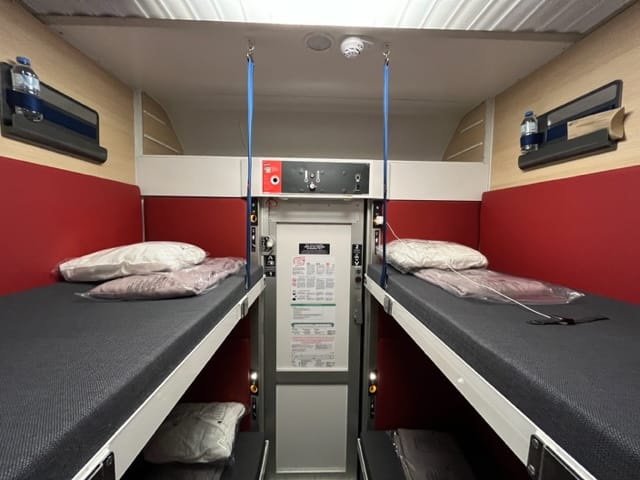
When President Emmanuel Macron announced a major renaissance of night trains in 2020, the ambition was clear: by 2030 France should operate a dense network of ten modern night train routes, reconnecting cities domestically and across Europe. Five years later, the vision has collided with fiscal reality, Nico Callens of Duurzaam Mobiel writes.
By the end of 2025, the French state finds itself in the uncomfortable position of wanting to expand night train services but lacking the financial means to do so.
The French night train revival is currently constrained by a severe shortage of rolling stock and a government facing acute budgetary pressure. In the initial phase of the revival programme, the strategy focused on renovating ageing Corail carriages from the 1980s. While this stopgap measure allowed several night services to return to the timetable, it was always clear that a genuine expansion would require a new generation of rolling stock. That step entails a multi-billion-euro investment to both expand the fleet and ultimately replace the refurbished legacy vehicles.
Optimism meets austerity logic
As recently as November 2025, there were signs of optimism. In a hearing before the French Senate, Transport Minister Philippe Tabarot confirmed the government’s intention to purchase 180 new passenger carriages and 27 locomotives.
A notable shift in policy is that, unlike in the past, it would be the French state itself, rather than the national railway company SNCF, that would own the new trains.
This strategy is closely linked to the liberalisation of the rail market. By the end of 2028, eight flagship night train routes, such as Paris–Nice, Paris–Toulouse, Paris–Tarbes and Paris–Rodez, must be tendered through public procurement procedures. If the state owns the rolling stock, it can make the fleet available to whichever operator wins the tender, whether SNCF or a new private entrant. This significantly lowers the barrier to entry for new players and creates a more level playing field in an emerging competitive market.
However, fiscal reality quickly undermined these ambitions. By December 2025, it became clear that France’s public finances were in a precarious state, with a budget deficit well above European thresholds. Sources within the government indicated that no financial coverage had been found for the planned rolling stock order in the 2026 budget.
Although the procurement procedure was formally launched in February 2025, the final signature has yet to be delivered. As a result, the actual arrival of new night train vehicles is now pushed back to 2029 or 2030 at the earliest.
This delay has serious implications: the planned tenders for the 2028–2030 period risk being undermined, as new operators could be forced to rely on increasingly outdated refurbished Corail coaches—a temporary solution that risks becoming permanent.
Cutbacks on international services
The consequences of the funding impasse became visible on international routes as well. At the end of 2025, the French government withdrew subsidies for the Paris–Berlin night train, citing the unsustainable cost of annual state support under the new budgetary framework.
Although the private operator European Sleeper takes over the route in March 2026 without subsidies and at its own commercial risk, the withdrawal of state backing sends a clear signal.
The French state appears eager to create a competitive night train market, but increasingly reluctant to provide the financial foundations required for that market to develop. This contradiction risks slowing down the entire revival strategy at a critical moment.
A network at a crossroads
France’s night train sector now stands at a crossroads. The blueprint for a modern, competitive night train network exists, and political rhetoric continues to emphasise the importance of rail as a sustainable alternative to aviation and car travel. Yet the empty public coffers are blocking the path forward.
The next decisive factor will be a long-awaited framework law on rail financing, expected in early 2026. This legislation is supposed to stabilise long-term rail funding and set the direction for French transport policy in the coming decades.
Without it, the promised renaissance risks remaining largely theoretical, confined to policy documents and a small fleet of ageing refurbished carriages rather than a truly modern night train network.
For now, the French night train revival can best be described as a case of political will constrained by financial inability. Whether the ambition can survive the austerity logic of Paris will determine the future of night rail in France; and, by extension, the credibility of Europe’s wider night train revival.