GERMANY | Bodycams for train guards and other public-facing staff at Deutsche Bahn after deadly attack

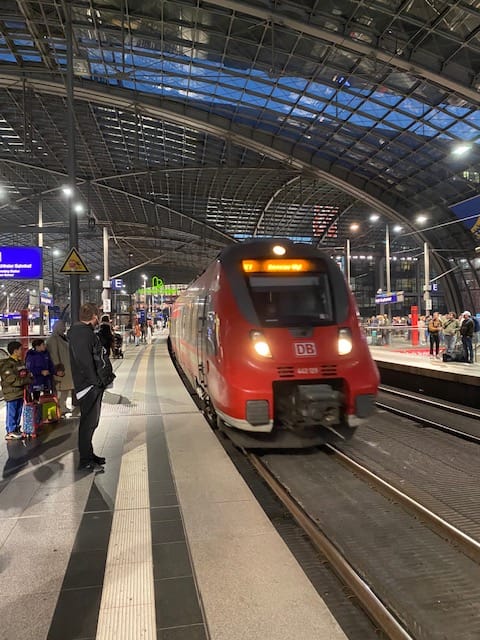
Germany is moving to introduce body-worn cameras for all customer-facing Deutsche Bahn (DB) employees and significantly strengthen security measures across the rail network, following the fatal assault of conductor Serkan Çalar during a ticket inspection earlier this month.
The decision was announced after an emergency security summit convened by DB Chief Executive Evelyn Palla, bringing together representatives from the federal government, the German states, trade unions and the transport industry to agree on a joint 'Action Plan for Greater Safety on the Railways'.
Immediate operational changes for frontline staff
Under the plan, from 2026 all DB staff with customer contact in local and long-distance services and at railway stations will be equipped with bodycams, with their use remaining voluntary.
The company will also deploy 200 additional DB Security officers at stations, improve personal protective equipment, expand behavioural and de-escalation training, and further roll out and upgrade the internal emergency 'priority call' alert system to ensure faster assistance in critical situations.
Ticket inspection procedures will also change: from 1 March 2026, inspectors in regional services will prioritise their own safety, and it will be at their discretion whether to request a passenger’s identification during a ticket check.
Strengthened police cooperation and regional security planning
DB and the Federal Police will continue their long-standing security partnership, maintaining high visibility at stations and along rail routes and ensuring rapid intervention in emergencies. Regional security workshops will be held to adapt measures to local conditions, with the aim of tailoring security concepts to specific stations and routes.
Longer-term reforms: surveillance, AI and staffing
Beyond the immediate steps, the action plan includes expanding video surveillance on trains and at stations, as well as enhanced and AI-supported analysis of video and audio recordings for early threat detection, subject to improved legal frameworks. Increased staffing levels on local trains will be discussed at the Conference of Transport Ministers at the end of March. The federal states are also considering further measures around the Deutschlandticket, including waiving ID checks to reduce confrontations and making the ticket more counterfeit-proof.
Legal reforms to protect rail employees
The plan proposes strengthening criminal-law protections for railway employees so that attacks on staff can be more effectively prosecuted. Relevant federal ministries intend to feed proposals into ongoing reforms of the Criminal Code, with concrete implementation steps to be agreed by the end of April 2026.
Rising violence against rail staff
The measures come amid a sustained rise in violence against rail employees. DB recorded 3,262 physical assaults against staff in 2025, including attempted and completed attacks—a slight decrease from the previous year but still at a very high level.
Over the past decade, assaults have increased by 37%, from 2,374 in 2016, with incidents commonly occurring during ticket inspections, enforcement of house rules or after major events. Serious and dangerous bodily harm remains rare, accounting for only one to two percent of cases, but unions warn that aggression levels are increasing, with a significant share of staff reporting fear of going to work.
Political and industry response
Federal Transport Minister Patrick Schnieder said that stations and trains must be safe places for both passengers and staff, expressing confidence that the agreed measures would lead to rapid improvements.
Evelyn Palla emphasised a zero-tolerance approach to violence and a shift towards prevention, stating that safety requires decisive action in personnel, technology and legal frameworks.
Christian Bernreiter, Chair of the Conference of Transport Ministers, described the killing as deeply shocking and said safety in public transport must be a top priority, welcoming the swift coordination between DB, federal and state authorities and the transport sector.
A turning point for rail security policy
The killing of Serkan Çalar, whose alleged attacker is in pretrial detention while prosecutors investigate manslaughter, has become a catalyst for a broader overhaul of rail security policy in Germany.
Officials describe the action plan as a turning point towards proactive prevention, faster assistance for staff and a stronger legal framework to deter and punish violence on the railways.