ITALY | Trenitalia unveils €2 billion investment plan and orders 74 new Frecciarossa high-speed trains

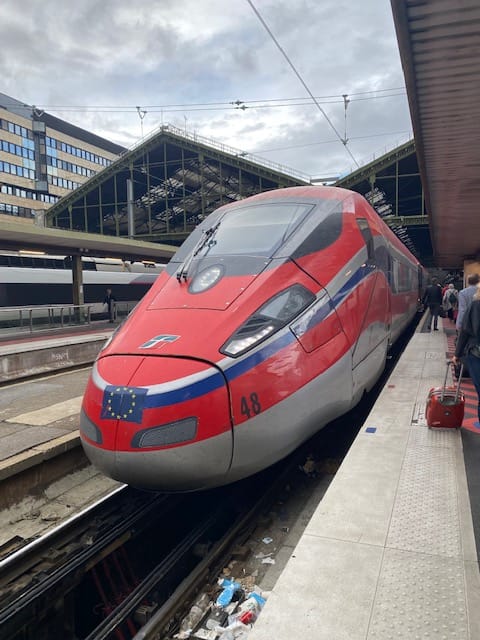
Trenitalia is accelerating towards 2030 with a major €2 billion investment programme aimed at strengthening its leadership in high-speed rail and transforming Italy’s passenger rail sector. Gianpiero Strisciuglio, Chief Executive Officer and General Manager of Trenitalia, outlined the strategy at the Forum Masseria Winter Edition, confirming the purchase of up to 74 new Frecciarossa 1000 high-speed trains and a comprehensive renewal of regional and long-distance rolling stock.
The expansion of the Frecciarossa fleet is the central pillar of the plan. The new trains, expected to be delivered progressively and fully operational around 2030, will significantly increase capacity on the busiest routes and support Trenitalia’s international expansion.
The company aims to position high-speed rail as a structural alternative to medium-distance air travel while reinforcing the Frecciarossa brand as one of Europe’s flagship rail products.
Expansion of an existing programme
The €2 billion order represents an expansion of an existing procurement programme.
In September, Trenitalia announced a contract for 36 Frecciarossa 1000 trains worth €1.3 billion, with options for additional units. Deliveries from the initial batch are already under way, with roughly ten trains per year expected until 2029.
The new trains are being built by Hitachi Rail at facilities in Pistoia and Naples and are designed for speeds of up to 300 km/h, with multi-system compatibility allowing operation in countries including Belgium, the Netherlands, France, Spain, Germany, Austria, and Switzerland.
New cross-border routes
International services are a key growth area. Trenitalia plans to launch new cross-border routes such as Munich–Milan and Munich–Rome, followed by Berlin–Milan, Munich–Naples and Berlin–Naples by 2028.
These services are intended to capture demand currently served by short- and medium-haul aviation, particularly once infrastructure upgrades such as the Brenner Base Tunnel reduce journey times further.
Regional and Intercity fleets
Beyond high-speed rail, Trenitalia is undertaking a major renewal of its regional and Intercity fleets.
By 2027, Italy’s regional fleet is expected to be the youngest in Europe, with an average train age of five to ten years, supported partly by funding from the National Recovery and Resilience Plan (PNRR). More than 80% of regional trains—over 1,000 out of a fleet of 1,300—are already of the latest generation. Intercity services will also receive more than 30 new hybrid, electric and battery-powered trains, improving efficiency on partially electrified routes.
Connectivity is another strategic priority. Trenitalia has tested a proprietary 5G network on the Turin–Milan line, reporting excellent performance, and is also exploring satellite solutions such as Starlink to eliminate coverage gaps. Improving onboard internet access is one of the most frequent requests from passengers, according to the company.
From a business perspective, the new rolling stock is designed to increase service frequency, optimise the use of existing infrastructure and support revenue growth. Trenitalia aims to improve energy efficiency, raise load factors and reduce operating costs per seat-kilometre, while the modernisation of regional and Intercity fleets is expected to improve reliability and punctuality and reduce the risks associated with ageing vehicles.
Overall, the investment programme is intended to consolidate Trenitalia’s position in the liberalised European rail market and strengthen rail as a central pillar of sustainable mobility in Italy and beyond.
Questions and uncertainties raised by railway observers
The announcement has triggered significant discussion among railway analysts and industry observers, who have highlighted several unresolved issues and ambiguities in the reporting.
Size and structure of the order
Rail analyst Jon Worth noted that Trenitalia already has around 50 ETR1000 trainsets from the first procurement tranche and questioned whether the new announcement represents an increase of the second tranche from 36 to around 72 units.
He also asked whether the widely discussed batch of Frecciarossa trains intended for France and potentially the United Kingdom is included within the 74-unit figure.
Observers have pointed out that trade press coverage has been inconsistent and sometimes contradictory, making it difficult to determine the precise scope of the order.
Cost per trainset and pricing realism
Several analysts, including Alon Levy, questioned the implied unit cost. If €2 billion covers 74 trainsets, this would suggest a price of roughly €27m per 200-metre high-speed train, which is unusually low by current European standards, where prices of €40–50 million per trainset are more typical. Some commentators suggested that the €2 billion figure might refer only to a follow-up tranche, with the overall programme cost being significantly higher.
Geographical deployment and international ambitions
Strisciuglio stated that the new trains would operate in seven countries outside Italy, without specifying which.
Observers noted that France, the UK, Austria, Germany and Spain are obvious candidates, but Belgium and the Netherlands have also been mentioned as potential markets.
However, analysts highlighted that Trenitalia has been relatively quiet about Benelux expansion plans in recent years, despite its ownership of Dutch operator Qbuzz, raising questions about the strategic priorities for northern Europe.
Allocation of rolling stock across markets
Speculation has emerged about how the new trains might be distributed. Some analysts suggested a hypothetical split between domestic Italian services, Germany and Austria via Netinera (FS’s German subsidiary), and France/UK operations.
Others pointed out that it remains unclear how many new Frecciarossa sets will replace older ETR500 units and how many will represent net capacity growth.
Infrastructure constraints and strategic timing
Commentators also noted that international expansion plans, particularly in the Benelux corridor, may be constrained by infrastructure issues, such as the ongoing problems on the Dutch HSL-Zuid. This could explain the lack of concrete announcements regarding Paris–Amsterdam or London services.
Overall, observers agree that the announcement signals a major expansion drive but argue that the details remain opaque. Much of the speculation stems from a single speech and fragmented reporting, with analysts awaiting clearer confirmation on order size, pricing, deployment strategy and international market priorities.
More on night trains and transcontinental train travel
- Deutsche Bahn confirms Cologne – Brussels Airport – Antwerp ICE connection from September 2026.
- Belgium and the Netherlands work on Brussels to Eindhoven direct train, possibly via Antwerp.
- Belgian Mobility Minister wants to revive direct train service to Switzerland.
- NETHERLANDS | Arriva will not launch the Groningen to Paris service in 2026.
- Booking headache deters almost two in three long-distance rail travellers, poll finds.
- Snälltåget to run Stockholm – Malmö – Copenhagen – Hamburg day trains from May 2026.
- Nox night trains: a smart new cabin concept or just an unachievable dream?.
- How firm are Eurostar and Deutsche Bahn’s “2030s” Germany to London train link plans?.
- Leo Express files plans for extraordinary 2026 Bratislava–Ostend and Venice–Northern Germany services.
- GoVolta re-emerges to offer train services from Amsterdam to Hamburg and to Berlin using Belgian I10 carriages.
- Deutsche Bahn to offer a Cologne – Ostend / Bruges / Ghent – Cologne high-speed train connection in the summer of 2026?.
- Rail should be functional, not fine art: EU leaders call for standardisation and lower costs.
- Subsidies for night trains? “You cannot fix this until someone builds more sleeper and couchette carriages”.
- European Sleeper to operate Paris – Brussels – Berlin night train route from March 2026.
- Leo Express and Arenaways plan direct train between Prague and Venice.
- Italo targets the German high-speed rail market.
- Trenitalia eyes expansion into Germany’s high-speed trains market.
- European Commission wants to link all EU capitals by high-speed train by 2040… and that’s not going to happen.
- Travellers in Europe increasingly open to choosing trains over planes for short-haul journeys.
- REVIEW | European Sleeper night train.
- Paris Nightjet axed: France’s withdrawal threatens Europe’s night train revival.
- 2026 | Deutsche Bahn plans 4 ICE’s per day between Cologne and Antwerp and 16 per day between Frankfurt and Brussels.
- Iron Rhine gets renewed political attention in Belgium, the Netherlands and Germany.
- ÖBB prioritises Railjet over Nightjet: Is the night train revival a False Dawn?.
- EUROPEAN SLEEPER | Brussels to Barcelona night train to stop in Avignon, Montpellier, Narbonne, and Girona.
- Trenitalia, Deutsche Bahn and ÖBB launch Frecciarossa EuroCity trains linking Berlin, Munich, Milan, Rome and Naples.
- European Commission commits to single-ticket train travel, Back-on-Track unconvinced it will happen.
- EU train travel report sees increase in cross-border passenger trains and easier bookings.
- Brussels to Luxembourg by train under 2 hours by 2030?.
- Eurostar and five more train operators joined the European Agreement on Journey Continuation.
- ÖBB’s new Nightjet sleeper cars accommodate solo travellers with Mini Cabins.
- Trenitalia orders new Hitachi Frecciarossa trains suited for France, Belgium and the Netherlands.
- EUROCITY EC-8 | Basel to Cologne in SBB’s Panoramic Car.
- REVIEW | Trenitalia Frecciarossa 1000 Paris – Milan in Business Executive.
- RAIL TOUR OF EUROPE | How easy is touring Europe by train?.
- Eight train connections between the Netherlands and Belgium by 2030?.
- REVIEW | ÖBB Nightjet Amsterdam – Zurich night train.
- Nightjet Vienna/Innsbruck to Brussels, or how we got thrown off the train in Aachen.
- Why the expensive ÖBB Nightjet is really not that expensive.
- Ticket Distribution: the failure of railways to sell themselves.
- To use night trains in Portugal and Spain or not?.
- Night trains in Europe.
- Low-cost, long-haul trains to conquer Europe?.
- Fly now before it’s taxed and consider using the train instead.
Channel Tunnel updates
- A London-bound Eurostar terminal at Antwerp-Central? Highly unlikely!.
- Trenitalia (FS Group) and Certares agree strategic partnership to expand international high-speed rail operations.
- #CROSSCHANNELRAIL | Expanding UK-Europe train links most realistically leading to Switzerland.
- CHANNEL TUNNEL | Virgin Trains gains access to Temple Mills, ORR snubs links to Germany and Switzerland.
- Eurostar unveils €2 billion Alstom ‘Celestia’ fleet of double-decker sustainable trains.
- Gemini Trains partners with Uber for Stratford to France Channel Tunnel route.
- Eurostar and St. Pancras Highspeed back major station expansion to double capacity amid growing international demand.
- EUROSTAR | London – Frankfurt, London – Geneva and Amsterdam – Antwerp – Brussels – Geneva from 2030?.
- Alstom wants its double-decker trains to ride through Channel Tunnel.
- Ferrovie dello Stato Italiane (FS) plan to launch a new high-speed link between London and Paris.
- London St. Pancras Highspeed pledges financial support for cross-Channel rail services.
- London St Pancras Highspeed and Getlink aspire to to triple train services to France, Belgium and the Netherlands and add services to Germany and Switzerland.
- Heuro wants to operate high speeds trains between Amsterdam, Antwerp, Brussels, Paris and London from 2028.